Illustrative reenactment - not a recorded Copilot session. Test results are real fixture runs.
Client: VS Code | official Spec Kit commands layout. Track: spec-kit.
Commands: /speckit.constitution, /speckit.specify, /speckit.clarify.
In the official Copilot skills layout, use /speckit-<step> instead of /speckit.<step>.
The dialogue and artifact snapshots below are authored examples. Test summaries are verbatim excerpts from real fixture runs; stack traces and machine-local paths are omitted.
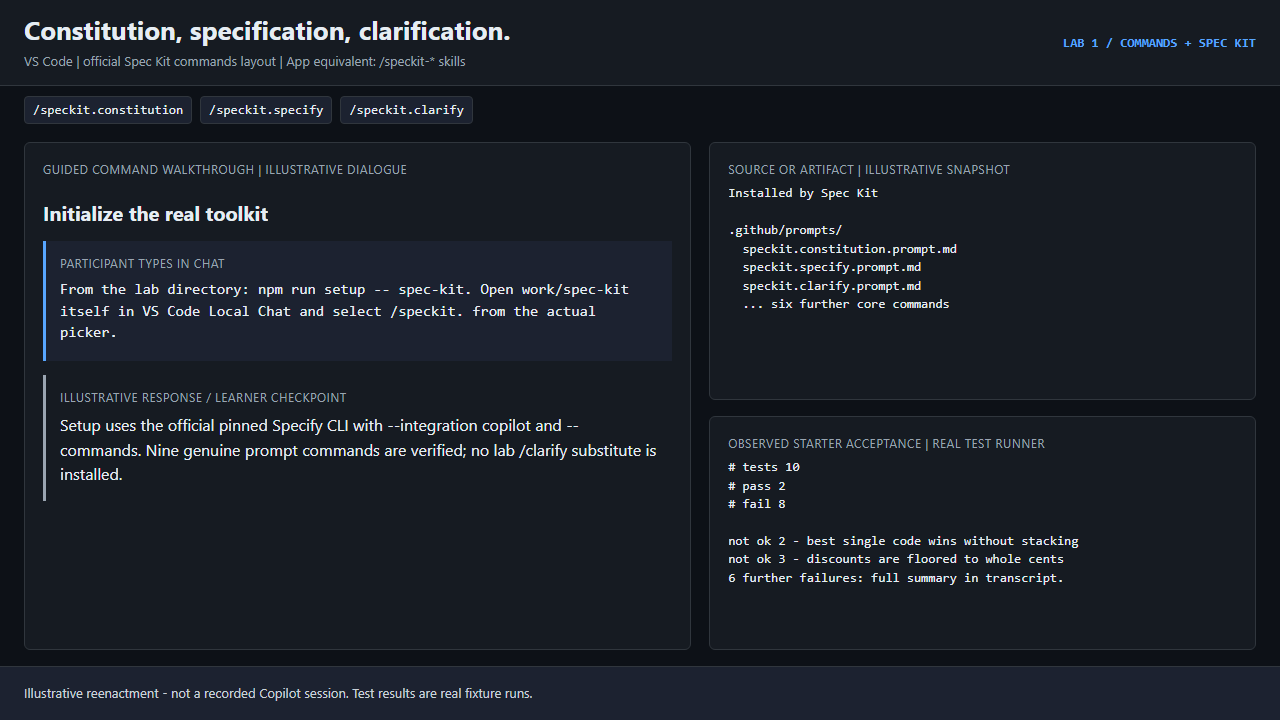
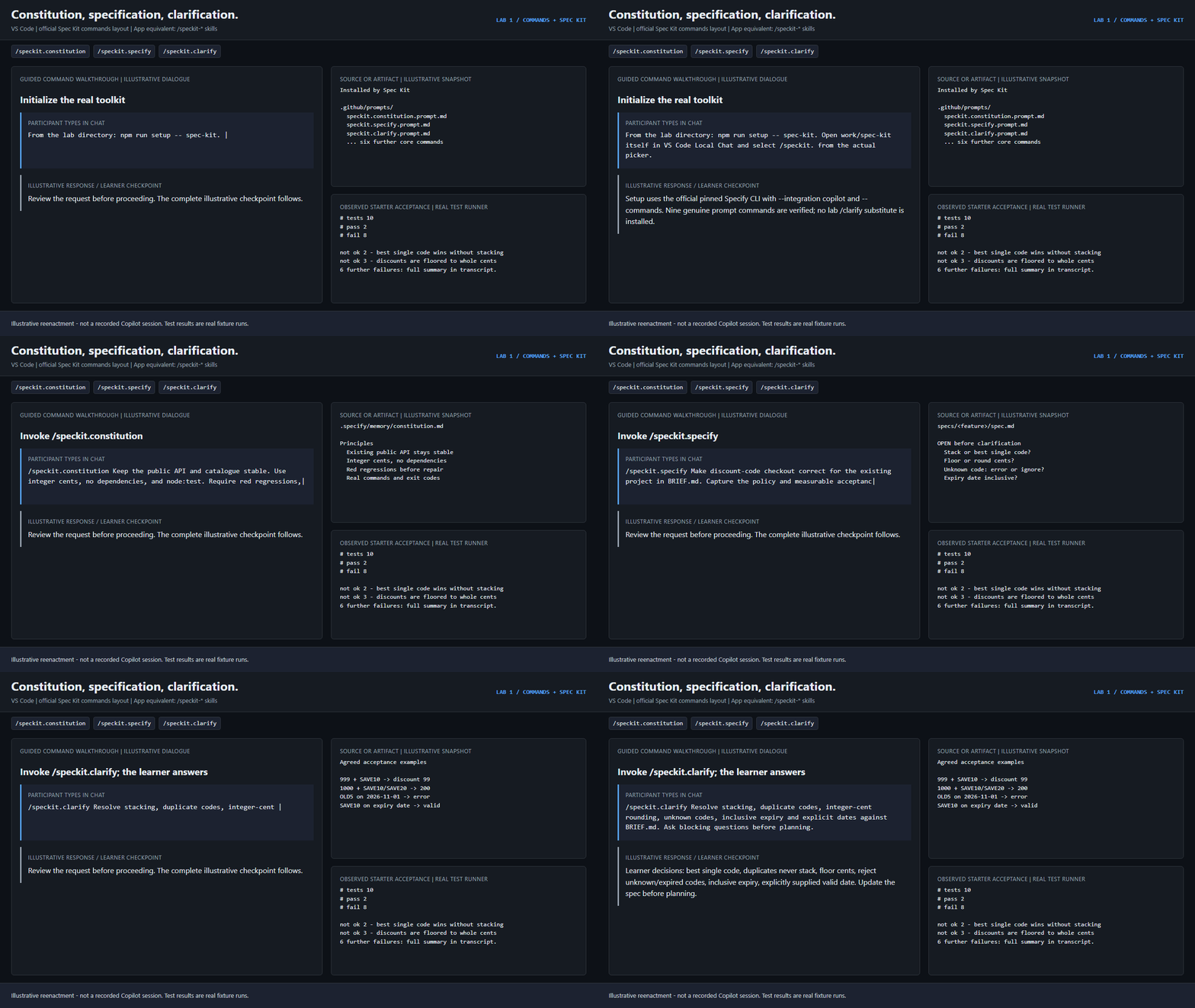
Step 1: Initialize the real toolkit
Participant:
From the lab directory: npm run setup -- spec-kit. Open work/spec-kit itself in VS Code Local Chat and select /speckit. from the actual picker.
Illustrative checkpoint:
Setup uses the official pinned Specify CLI with --integration copilot and --commands. Nine genuine prompt commands are verified; no lab /clarify substitute is installed.
Source or artifact snapshot:
Installed by Spec Kit

.github/prompts/
  speckit.constitution.prompt.md
  speckit.specify.prompt.md
  speckit.clarify.prompt.md
  ... six further core commands
Observed test summary:
ok 1 - no codes leaves the subtotal unchanged
not ok 2 - best single code wins without stacking
not ok 3 - discounts are floored to whole cents
not ok 4 - duplicate codes do not stack
not ok 5 - unknown and expired codes are rejected
not ok 6 - invalid inputs are rejected
not ok 7 - large cent amounts remain exact
ok 8 - catalogue inputs and public API are preserved
not ok 9 - learner regressions catch the original bug
not ok 10 - constitution and feature artifacts are ready
# tests 10
# suites 0
# pass 2
# fail 8
# cancelled 0
# skipped 0
# todo 0
Step 2: Invoke /speckit.constitution
Participant:
/speckit.constitution Keep the public API and catalogue stable. Use integer cents, no dependencies, and node:test. Require red regressions, explicit errors, real verification and no unrelated edits.
Illustrative checkpoint:
Agree on constraints once. Later plans and tasks must respect them. The illustrative artifact below is a reference snapshot, not captured agent output.
Source or artifact snapshot:
.specify/memory/constitution.md

Principles
  Existing public API stays stable
  Integer cents, no dependencies
  Red regressions before repair
  Real commands and exit codes
Observed test summary:
ok 1 - no codes leaves the subtotal unchanged
not ok 2 - best single code wins without stacking
not ok 3 - discounts are floored to whole cents
not ok 4 - duplicate codes do not stack
not ok 5 - unknown and expired codes are rejected
not ok 6 - invalid inputs are rejected
not ok 7 - large cent amounts remain exact
ok 8 - catalogue inputs and public API are preserved
not ok 9 - learner regressions catch the original bug
not ok 10 - constitution and feature artifacts are ready
# tests 10
# suites 0
# pass 2
# fail 8
# cancelled 0
# skipped 0
# todo 0
Step 3: Invoke /speckit.specify
Participant:
/speckit.specify Make discount-code checkout correct for the existing project in BRIEF.md. Capture the policy and measurable acceptance criteria before implementation. Do not change code yet.
Illustrative checkpoint:
Describe what checkout must do, not a new technology stack. The vague product request needs explicit rules for multiple codes, expiry and cent rounding.
Source or artifact snapshot:
specs/<feature>/spec.md

OPEN before clarification
  Stack or best single code?
  Floor or round cents?
  Unknown code: error or ignore?
  Expiry date inclusive?
Observed test summary:
ok 1 - no codes leaves the subtotal unchanged
not ok 2 - best single code wins without stacking
not ok 3 - discounts are floored to whole cents
not ok 4 - duplicate codes do not stack
not ok 5 - unknown and expired codes are rejected
not ok 6 - invalid inputs are rejected
not ok 7 - large cent amounts remain exact
ok 8 - catalogue inputs and public API are preserved
not ok 9 - learner regressions catch the original bug
not ok 10 - constitution and feature artifacts are ready
# tests 10
# suites 0
# pass 2
# fail 8
# cancelled 0
# skipped 0
# todo 0
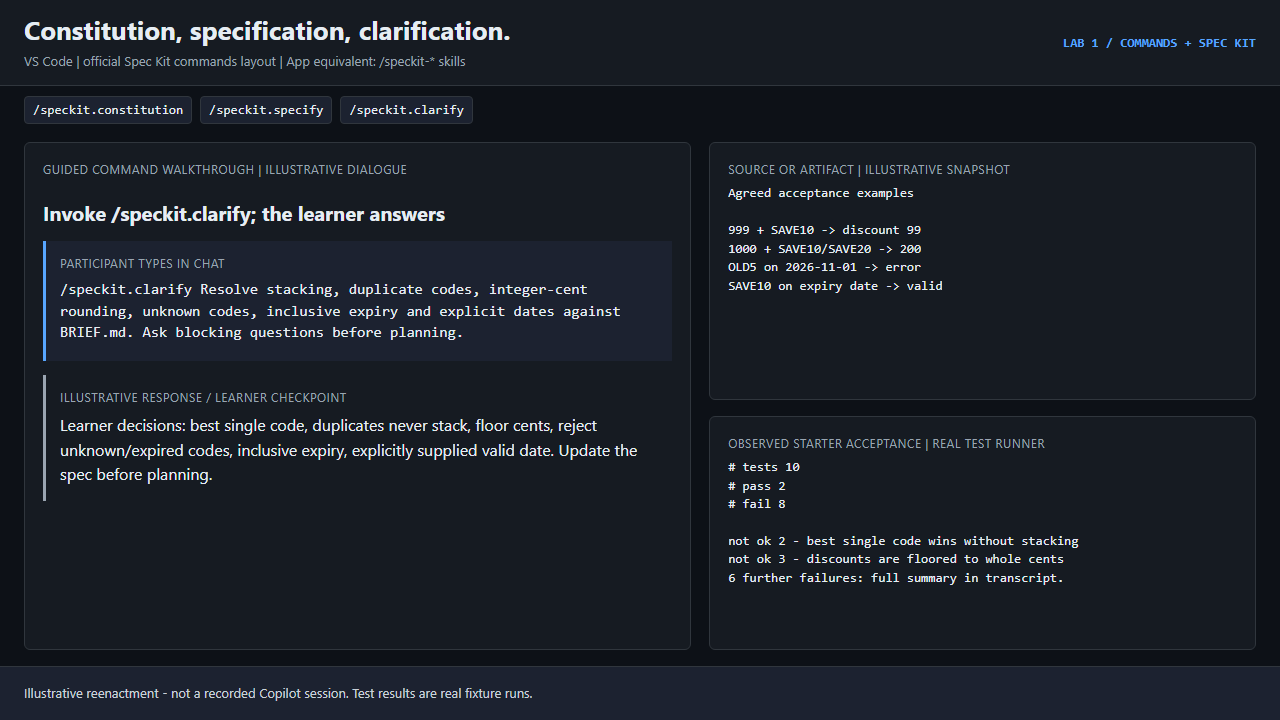
Step 4: Invoke /speckit.clarify; the learner answers
Participant:
/speckit.clarify Resolve stacking, duplicate codes, integer-cent rounding, unknown codes, inclusive expiry and explicit dates against BRIEF.md. Ask blocking questions before planning.
Illustrative checkpoint:
Learner decisions: best single code, duplicates never stack, floor cents, reject unknown/expired codes, inclusive expiry, explicitly supplied valid date. Update the spec before planning.
Source or artifact snapshot:
Agreed acceptance examples

999 + SAVE10 -> discount 99
1000 + SAVE10/SAVE20 -> 200
OLD5 on 2026-11-01 -> error
SAVE10 on expiry date -> valid
Observed test summary:
ok 1 - no codes leaves the subtotal unchanged
not ok 2 - best single code wins without stacking
not ok 3 - discounts are floored to whole cents
not ok 4 - duplicate codes do not stack
not ok 5 - unknown and expired codes are rejected
not ok 6 - invalid inputs are rejected
not ok 7 - large cent amounts remain exact
ok 8 - catalogue inputs and public API are preserved
not ok 9 - learner regressions catch the original bug
not ok 10 - constitution and feature artifacts are ready
# tests 10
# suites 0
# pass 2
# fail 8
# cancelled 0
# skipped 0
# todo 0
Takeaway: Resolve stacking, rounding and expiry before design or code; app skills use /speckit-*.
Try it yourself: Lab 1: /commands + Spec Kit. Set up first with the lab environment guide.