Illustrative reenactment - not a recorded Copilot session. Test results are real fixture runs.
Client: VS Code | official Spec Kit commands layout. Track: spec-kit.
Commands: /speckit.plan, /speckit.checklist, /speckit.tasks, /speckit.analyze.
In the official Copilot skills layout, use /speckit-<step> instead of /speckit.<step>.
The dialogue and artifact snapshots below are authored examples. Test summaries are verbatim excerpts from real fixture runs; stack traces and machine-local paths are omitted.
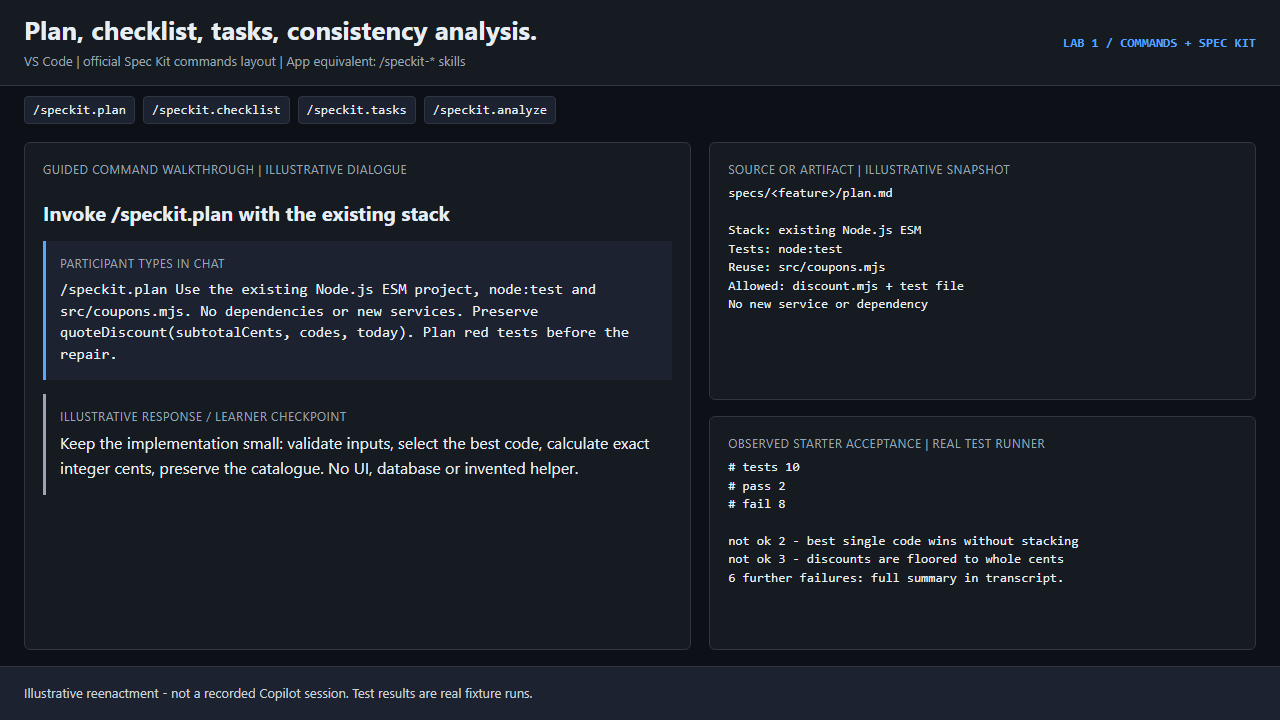
Step 1: Invoke /speckit.plan with the existing stack
Participant:
/speckit.plan Use the existing Node.js ESM project, node:test and src/coupons.mjs. No dependencies or new services. Preserve quoteDiscount(subtotalCents, codes, today). Plan red tests before the repair.
Illustrative checkpoint:
Keep the implementation small: validate inputs, select the best code, calculate exact integer cents, preserve the catalogue. No UI, database or invented helper.
Source or artifact snapshot:
specs/<feature>/plan.md

Stack: existing Node.js ESM
Tests: node:test
Reuse: src/coupons.mjs
Allowed: discount.mjs + test file
No new service or dependency
Observed test summary:
ok 1 - no codes leaves the subtotal unchanged
not ok 2 - best single code wins without stacking
not ok 3 - discounts are floored to whole cents
not ok 4 - duplicate codes do not stack
not ok 5 - unknown and expired codes are rejected
not ok 6 - invalid inputs are rejected
not ok 7 - large cent amounts remain exact
ok 8 - catalogue inputs and public API are preserved
not ok 9 - learner regressions catch the original bug
not ok 10 - constitution and feature artifacts are ready
# tests 10
# suites 0
# pass 2
# fail 8
# cancelled 0
# skipped 0
# todo 0
Step 2: Invoke /speckit.checklist; review requirements
Participant:
/speckit.checklist Review whether stacking, duplicate handling, cent precision, expiry, invalid input and frozen scope are complete, clear and testable. Do not treat this as a passing code test.
Illustrative checkpoint:
A human reviews custom checklist items against the specification. Do not blindly mark every box to make implementation proceed. A checked requirement is not verified code.
Source or artifact snapshot:
Requirements-quality checklist

[ ] Non-stacking is unambiguous
[ ] Expiry boundary is explicit
[ ] Large-cent precision is testable
[ ] Invalid-input behavior is defined

Still no runtime pass claim.
Observed test summary:
ok 1 - no codes leaves the subtotal unchanged
not ok 2 - best single code wins without stacking
not ok 3 - discounts are floored to whole cents
not ok 4 - duplicate codes do not stack
not ok 5 - unknown and expired codes are rejected
not ok 6 - invalid inputs are rejected
not ok 7 - large cent amounts remain exact
ok 8 - catalogue inputs and public API are preserved
not ok 9 - learner regressions catch the original bug
not ok 10 - constitution and feature artifacts are ready
# tests 10
# suites 0
# pass 2
# fail 8
# cancelled 0
# skipped 0
# todo 0
Step 3: Invoke /speckit.tasks; keep tests first
Participant:
/speckit.tasks Include at least four node:test cases in src/discount.test.mjs importing ./discount.mjs. Run them red before fixing src/discount.mjs, then run npm test and npm run check.
Illustrative checkpoint:
Make requirements traceable to ordered tasks. Add regression cases before the implementation task, then verify the frozen API and catalogue.
Source or artifact snapshot:
Illustrative tasks.md snapshot

T001 Red regressions -> policy rules
T002 Input validation -> error rules
T003 Best-code and exact-cent repair
T004 Independent check + scope review

Order prevents happy-path-only proof.
Observed test summary:
ok 1 - no codes leaves the subtotal unchanged
not ok 2 - best single code wins without stacking
not ok 3 - discounts are floored to whole cents
not ok 4 - duplicate codes do not stack
not ok 5 - unknown and expired codes are rejected
not ok 6 - invalid inputs are rejected
not ok 7 - large cent amounts remain exact
ok 8 - catalogue inputs and public API are preserved
not ok 9 - learner regressions catch the original bug
not ok 10 - constitution and feature artifacts are ready
# tests 10
# suites 0
# pass 2
# fail 8
# cancelled 0
# skipped 0
# todo 0
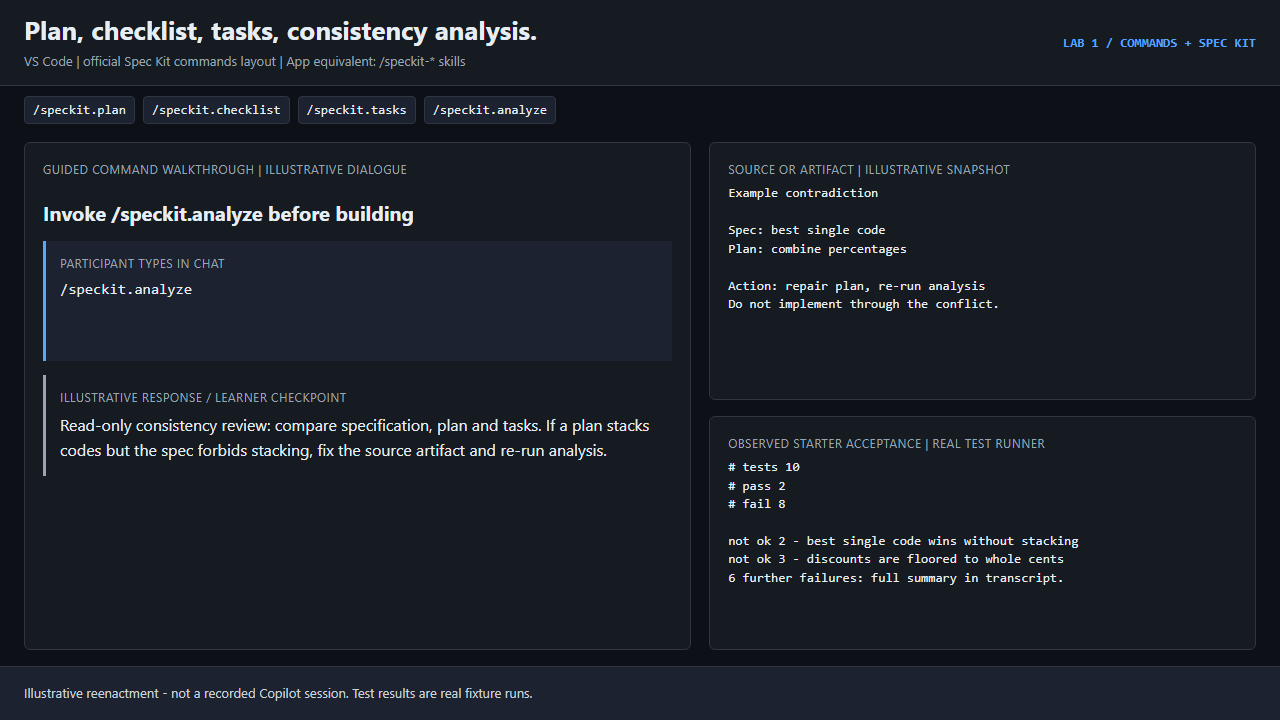
Step 4: Invoke /speckit.analyze before building
Participant:
/speckit.analyze
Illustrative checkpoint:
Read-only consistency review: compare specification, plan and tasks. If a plan stacks codes but the spec forbids stacking, fix the source artifact and re-run analysis.
Source or artifact snapshot:
Example contradiction

Spec: best single code
Plan: combine percentages

Action: repair plan, re-run analysis
Do not implement through the conflict.
Observed test summary:
ok 1 - no codes leaves the subtotal unchanged
not ok 2 - best single code wins without stacking
not ok 3 - discounts are floored to whole cents
not ok 4 - duplicate codes do not stack
not ok 5 - unknown and expired codes are rejected
not ok 6 - invalid inputs are rejected
not ok 7 - large cent amounts remain exact
ok 8 - catalogue inputs and public API are preserved
not ok 9 - learner regressions catch the original bug
not ok 10 - constitution and feature artifacts are ready
# tests 10
# suites 0
# pass 2
# fail 8
# cancelled 0
# skipped 0
# todo 0
Takeaway: A requirements checklist is not a runtime test. Resolve contradictions before implementation.
Try it yourself: Lab 1: /commands + Spec Kit. Set up first with the lab environment guide.