Illustrative reenactment - not a recorded Copilot session. Test results are real fixture runs.
Client: VS Code / Copilot app | obra/superpowers. Track: skills.
Commands: /systematic-debugging.
The dialogue and artifact snapshots below are authored examples. Test summaries are verbatim excerpts from real fixture runs; stack traces and machine-local paths are omitted.
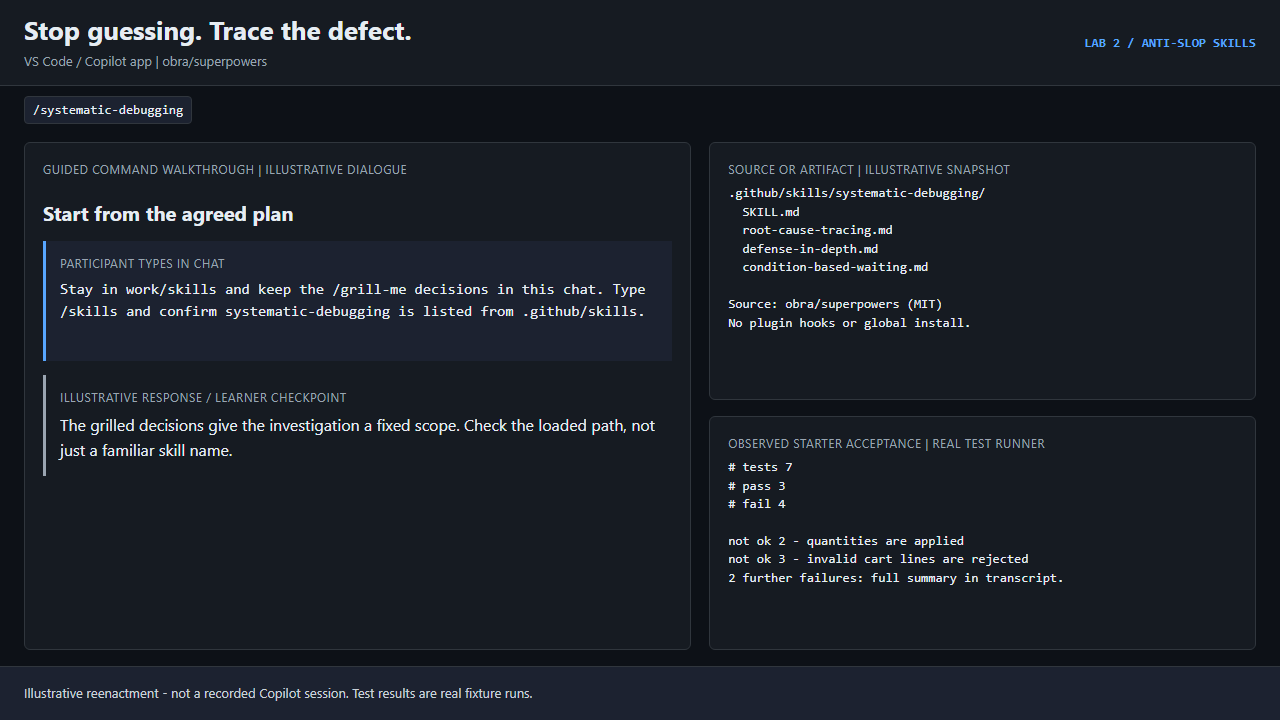
Step 1: Start from the agreed plan
Participant:
Stay in work/skills and keep the /grill-me decisions in this chat. Type /skills and confirm systematic-debugging is listed from .github/skills.
Illustrative checkpoint:
The grilled decisions give the investigation a fixed scope. Check the loaded path, not just a familiar skill name.
Source or artifact snapshot:
.github/skills/systematic-debugging/
  SKILL.md
  root-cause-tracing.md
  defense-in-depth.md
  condition-based-waiting.md

Source: obra/superpowers (MIT)
No plugin hooks or global install.
Observed test summary:
ok 1 - existing cart behavior is preserved
not ok 2 - quantities are applied
not ok 3 - invalid cart lines are rejected
not ok 4 - safe integer cents are enforced
ok 5 - inputs are left untouched
ok 6 - public API and scope are preserved
not ok 7 - learner regressions catch the original bug
# tests 7
# suites 0
# pass 3
# fail 4
# cancelled 0
# skipped 0
# todo 0
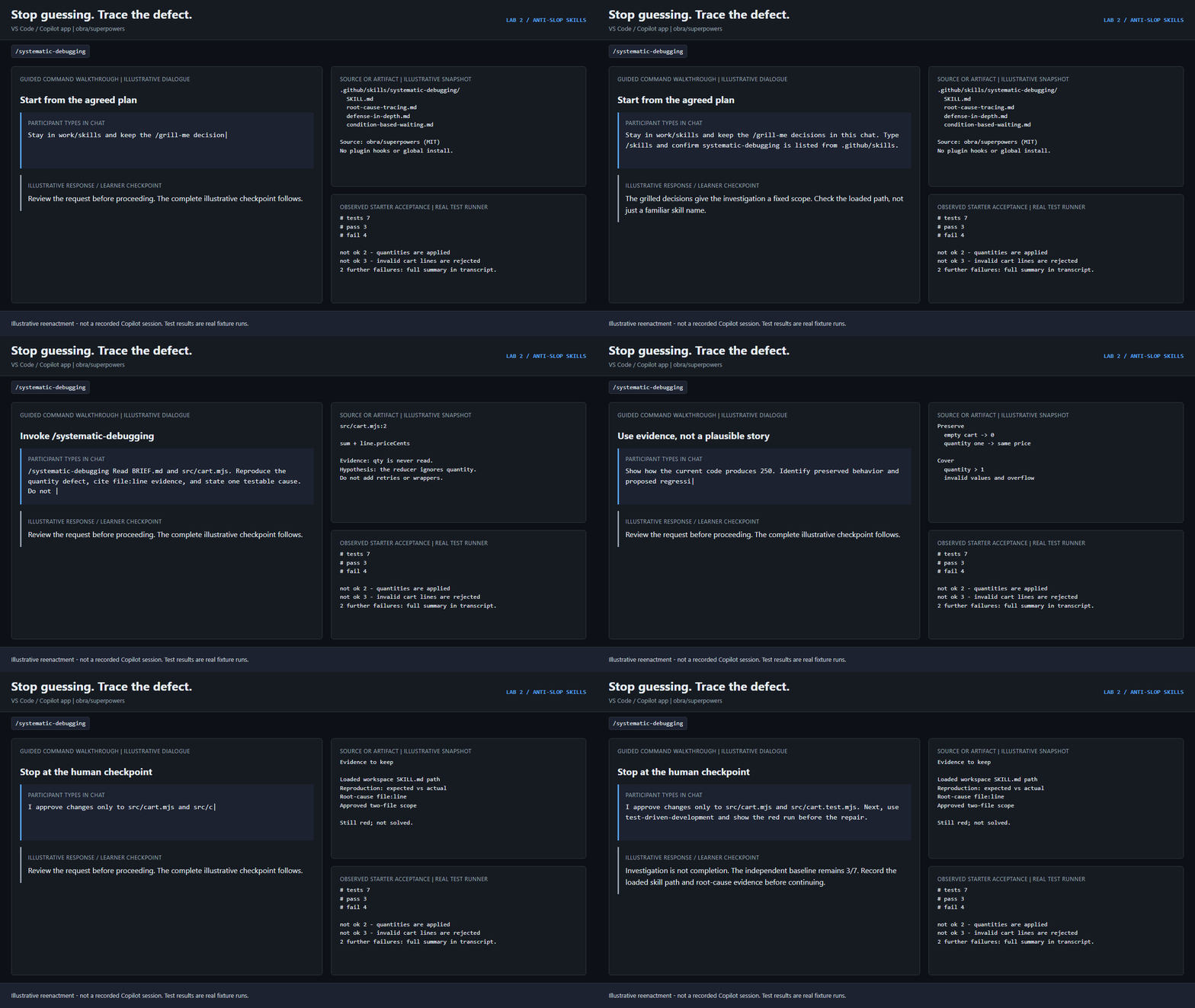
Step 2: Invoke /systematic-debugging
Participant:
/systematic-debugging Read BRIEF.md and src/cart.mjs. Reproduce the quantity defect, cite file:line evidence, and state one testable cause. Do not edit yet. Keep investigation inside this disposable workspace.
Illustrative checkpoint:
Reproduce with priceCents 250 and qty 3. Expected 750, observed 250. The reducer adds price once instead of multiplying by quantity.
Source or artifact snapshot:
src/cart.mjs:2

sum + line.priceCents

Evidence: qty is never read.
Hypothesis: the reducer ignores quantity.
Do not add retries or wrappers.
Observed test summary:
ok 1 - existing cart behavior is preserved
not ok 2 - quantities are applied
not ok 3 - invalid cart lines are rejected
not ok 4 - safe integer cents are enforced
ok 5 - inputs are left untouched
ok 6 - public API and scope are preserved
not ok 7 - learner regressions catch the original bug
# tests 7
# suites 0
# pass 3
# fail 4
# cancelled 0
# skipped 0
# todo 0
Step 3: Use evidence, not a plausible story
Participant:
Show how the current code produces 250. Identify preserved behavior and proposed regressions. Do not implement until I approve.
Illustrative checkpoint:
Empty carts and quantity one already work. New tests must cover quantity, bad input and unsafe arithmetic without changing legacy pricing.
Source or artifact snapshot:
Preserve
  empty cart -> 0
  quantity one -> same price

Cover
  quantity > 1
  invalid values and overflow
Observed test summary:
ok 1 - existing cart behavior is preserved
not ok 2 - quantities are applied
not ok 3 - invalid cart lines are rejected
not ok 4 - safe integer cents are enforced
ok 5 - inputs are left untouched
ok 6 - public API and scope are preserved
not ok 7 - learner regressions catch the original bug
# tests 7
# suites 0
# pass 3
# fail 4
# cancelled 0
# skipped 0
# todo 0
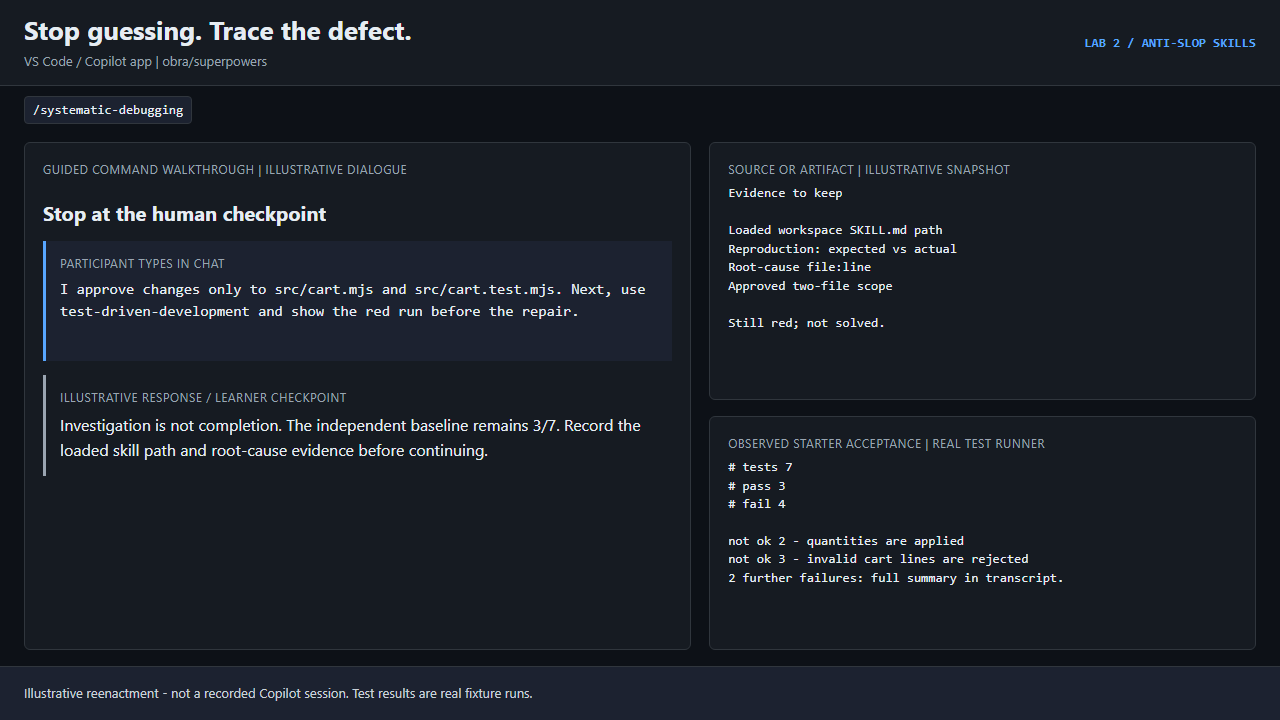
Step 4: Stop at the human checkpoint
Participant:
I approve changes only to src/cart.mjs and src/cart.test.mjs. Next, use test-driven-development and show the red run before the repair.
Illustrative checkpoint:
Investigation is not completion. The independent baseline remains 3/7. Record the loaded skill path and root-cause evidence before continuing.
Source or artifact snapshot:
Evidence to keep

Loaded workspace SKILL.md path
Reproduction: expected vs actual
Root-cause file:line
Approved two-file scope

Still red; not solved.
Observed test summary:
ok 1 - existing cart behavior is preserved
not ok 2 - quantities are applied
not ok 3 - invalid cart lines are rejected
not ok 4 - safe integer cents are enforced
ok 5 - inputs are left untouched
ok 6 - public API and scope are preserved
not ok 7 - learner regressions catch the original bug
# tests 7
# suites 0
# pass 3
# fail 4
# cancelled 0
# skipped 0
# todo 0
Takeaway: Load the actual upstream skill, reproduce the bug, then approve a bounded hypothesis.
Try it yourself: Lab 2: anti-slop skills. Set up first with the lab environment guide.